


The Reflex Sport helmet, with a carbon fiber or fiberglass composite shell, has a well-thought-out design with new Koroyd® energy damping technology integrated into a high-quality dual-density EPS liner, combined with the MIPS concussion protection system in the Mips® Integra comfort padding. The Reflex Sport embodies the unity of style and technology, creating a first-class product that professional racers and off-road enthusiasts alike can rely on.
Let’s be honest — motorcycle helmets look great, and you’d like to keep yours looking like new for as long as possible. Over many years of practice we have worked out several effective ways to do this, and we are happy to share them.
We strongly do not recommend using solvents, carburetor cleaner, brake fluid or any other substances in the cans, tins and bottles lying around your garage, including unlabeled ones, to clean your helmet. Chemicals and strong solvents can seriously damage the materials the helmet is made of — please don’t do that to your helmet!
* Never wash or dry the liner in a washing machine or dryer.
Protecting your helmet during long-term storage is definitely a good idea. Keep the helmet in the special bag included. Store it in a safe, dry place out of direct sunlight.
The visor surface must be cleaned very carefully to avoid scratches. Place a clean, warm, damp, soft cloth over the outside of the visor for at least 5 minutes to soften dried bugs and dirt (don’t skip this step!). Then gently clean the visor with a clean soft cloth, warm water and mild soap. After that, wipe the visor with a clean soft cloth dampened with clean water to remove soap residue. Dry the visor by gently wiping it with a clean soft cloth.
Never use solvents, window or glass cleaners, or any other chemical cleaners to clean the visor.
Do not apply decals, tape or stickers to the visor.
If your visor has an anti-scratch or anti-fog coating, keep in mind that household cleaners (such as glass cleaners, all-purpose sprays, furniture polish) can leave unwanted marks and in some cases damage the visor itself.
Do not use any cleaners or detergents on the inside of the visor. Using anything other than a clean soft or microfiber cloth and water to gently wipe the inside of the visor can damage or reduce the effectiveness of the anti-fog coating.
Protect the visor when it is not fitted to the helmet. Store the visor in a dry, safe place, away from direct sunlight and extremely high or low temperatures. Make sure the visor cannot be scratched, damaged by impact or otherwise deformed, is not under heavy objects and is not stored near fuel or solvents. We recommend storing the visor in a soft microfiber bag or pouch.
If your helmet has an internal drop-down visor, be sure to follow the same instructions, as they also apply to the internal drop-down visor.
Although a helmet is hard and has a very strong and reliable construction, it requires careful handling. Dropping a helmet on asphalt or another hard surface can significantly impair its functionality. The user should be aware that an impact may cause damage that is invisible to the eye.
The riding gear manufacturer ICON Motosports warns: when taking part in activities that require a helmet on your head, it is strongly recommended to avoid hitting your head on anything whatsoever. If you suspect reduced helmet functionality, or after ANY impact during use, replace the helmet. We guarantee it will cost less.
No motorcycle helmet in the world can protect against ALL possible impacts. For your safety, you need to choose a helmet that fits correctly. For maximum head protection, the helmet must fit snugly and follow the shape of your skull as closely as possible. To work properly, the helmet must be securely fastened under the chin.
Wrap a flexible measuring tape around your head at its widest point above the eyebrows and ears.
Using this measurement, find your size in the size charts below according to the helmet brand and model:
ICON AIRFLITE / DOMAIN / THRESHOLD
BILTWELL LANE SPLITTER / GRINGO S SV
THOR FLEET / SECTOR 2
| Shell | 2XS | XS | S | M | L | XL | 2XL | 3XL |
|---|---|---|---|---|---|---|---|---|
| Circumference cm | 51–52 | 53–54 | 55–56 | 57–58 | 59–60 | 61–62 | 63–64 | 65–66 |
ICON ULTRAFLITE / AIRFRAME PRO
THOR REFLEX
| Shell | XS | S | M | L | XL | 2XL | 3XL |
|---|---|---|---|---|---|---|---|
| Circumference cm | 54–55 | 55–56 | 57–58 | 58–59 | 60–61 | 62–63 | 64–65 |
ICON AIRFORM
| Shell | XS | S | M | L | XL | 2XL | 3XL |
|---|---|---|---|---|---|---|---|
| Circumference cm | 53–54 | 55–56 | 57–58 | 58–59 | 60–61 | 62–63 | 64–65 |
Skull shape in the horizontal plane is just as important as circumference. To determine your head shape, put on a balaclava (it will flatten your hair) and take a photo of your head from above, or ask someone to assess it. Round head — width and length are almost the same, it fits into a circle. Intermediate oval head — slightly longer than it is wide, the most common skull shape, it fits into a regular oval. Long oval — noticeably longer than it is wide, it fits into a narrow oval.
Different helmet models are made for different skull shapes — keep this in mind when choosing a helmet:
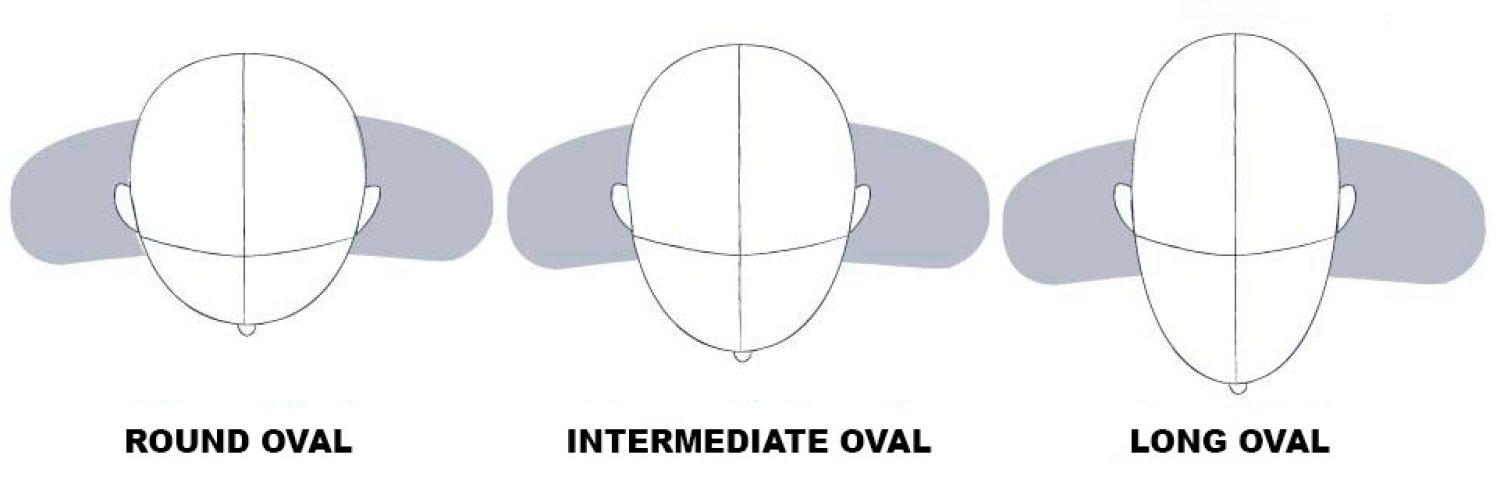

If you can’t determine your head shape (this sometimes happens), it is most likely an intermediate oval, because a round head shape (equal length and width) is the most obvious.
If your head shape doesn’t match the helmet shape, you need to go one or two sizes up, depending on how big the difference in skull oval is. In that case the liner will fit your skull unevenly and not over its whole area, which has a negative effect on impact energy absorption as well as on the helmet’s noise insulation.
NOTE: The helmet’s inner pads compress with use — keep this in mind when trying it on. The helmet should fit snugly and should not press painfully on your skull. The pressure on your cheeks can be quite strong, and they may be squeezed. The cheek pads are the thickest and compress the most.
We don’t believe you need to wear a helmet for a while to get used to it. A helmet chosen correctly by size and shape fits comfortably and snugly right away — proven by hundreds of customers! The only thing that may be uncomfortable is a tight entry when taking the helmet off and putting it on. Over time the pads at the entry will soften, and the helmet will be much easier to put on and take off. Focus on how your head feels inside the helmet!
A technology, built into helmets and designed to help reduce rotational motion to the head that could occur in so-called oblique impacts.
We have over 25 years of research into rotational motion and helmet safety, and an abundance of studies and data that say the same thing: in the vast majority of accidents in which someone hits their head, the impact is oblique, and an oblique impact entails an increased risk of brain damage. The same thing goes for objects falling from above at, for instance, a building site: they cause an oblique impact — even if you are standing still.

The moment your head hits the ground at an angle, rotational motion can make the head rotate more or less, depending on the impacting object or surface. The energy from the impact can be directed further into the head, which can cause brain injury. Rotational motion is thus the result of oblique impacts to the head.

The brain is more sensitive to oblique impacts versus straight impacts. Oblique impacts are also much more common. But most helmets on the market today are only tested and approved for straight impacts, even though these kinds of accidents are far less common.
Everything revolves around the Mips low-friction layer. It mimics the brain’s own protective system, which allows the brain to move slightly inside the head. The Mips system is designed to work on the same principle. The low-friction layer is built into the helmet and makes the energy-absorbing layers (the “padding”) mobile so that the head can move 10–15 mm inside the helmet on impact.

The Mips® safety system is available in different designs for different areas of use, but the principle is the same for all options. The system is attached to the helmet with elastic material, ensuring that the low-friction bearing is always in the proper position. The low-friction bearing has also been specially engineered to fit each helmet model and size and is injection-molded to fit perfectly inside each individual helmet. It provides a minimalist, fully integrated design that neither interferes with the helmet’s fit nor affects the weight more than marginally. A Mips system weighs between 20 and 45 grams.
Mips is a technology that is based on many years of research into the brain and brain damage, and we are firmly rooted in science. Our story begins in 1995, when brain surgeon Hans von Holst from Karolinska Institutet in Stockholm, Sweden, began researching helmet construction. He based his research on the realization that the helmets available at the time did not offer sufficient protection against brain damage. He contacted the KTH Royal Institute of Technology in Stockholm to initiate biomechanical research on the prevention of head and neck injuries.

The initiative led to what is now recognized as one of the most important Finite Element (FE) models of the human brain in the world. The model is an important research tool for Mips when it comes to visualizing and measuring the effects of the Mips system. Our first product was a proprietary riding helmet launched in 2007. Since then, Mips has become an “ingredient brand,” which means we sell our technology to other manufacturers, who in turn incorporate it into their products. Today, our safety systems are found in helmets for everything from skiing and cycling to construction and industry.

Koroyd welded tubes crush instantly and consistently on impact, absorbing maximum force in a controlled way and minimizing the energy transferred to your head. Traditional energy absorbers act like a spring, storing energy from the impact and releasing it over micro-moments. Because of this, more energy can be transferred to the head, increasing the risk of injury.
So even after a traditional energy absorber has fully compressed to its limit of densification, the absorbed energy can still pose a danger to the helmet wearer. This risk is higher with EPS foam.
When Koroyd is hit, energy is better absorbed through sacrificial plastic deformation. The material acts as a true energy absorber rather than a spring, crushing, absorbing and protecting the wearer.

Koroyd’s unique behavior helps protect your skull and brain from direct and oblique impacts, which can reduce the risk of a life-changing injury. Research shows that in an oblique impact, when linear acceleration is reduced through energy absorption, there is a 91% correlation with a reduction in the rotational motion of your head and brain. Simply put, if your motorcycle helmet absorbs more energy, you are better protected from any impact angle.

Air constantly flows through Koroyd’s open cells, which means hot air from your head can escape easily, providing more effective cooling in the most intense conditions. In contrast, traditional impact foams such as expanded polystyrene (EPS) are rigid and strong; they were originally used for food packaging and building insulation. In helmets with Koroyd, the continuous tubular structure provides maximum ventilation across the whole protector area — without compromising safety.

Koroyd has the thinnest-walled tubes in the world, resulting in a structure that is 95% air. This reduces weight and increases comfort without compromising safety. Traditionally, when removing material to save weight, helmet manufacturers have had to compromise on safety, since less material thickness can mean less protection. With Koroyd that is not the case. Because the welded tubular structure is ultra-light, strong and has better energy-absorbing properties, we can reduce weight while improving impact protection.

Koroyd provides improved breathability and ultra-light weight, but above all better protection that reduces the risk of a life-threatening injury.
“Koroyd is the only material specifically developed to significantly improve energy absorption and therefore helmet safety. Improving helmet safety depends on how well you can manage impact energy.
This usually means increasing the amount of energy-absorbing material used in the helmet, or using materials that absorb energy more effectively.
Traditional materials were empirically derived from those used in the packaging industry, and helmet safety standards reflect this.”
Peter Sajic, PhD.


