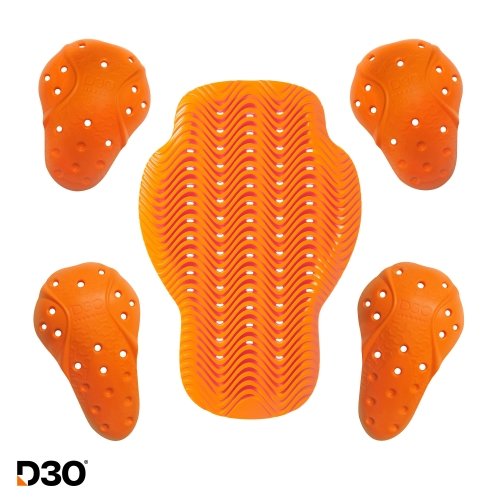
With a 4-way stretch textile chassis combined with the ICON® Sport Fit cut, the Hella2™ ladies jacket is both light and strong. Chest and wrist vents combined with a concealed exhaust provide free airflow and the comfort that comes with it. Inside, the Hella2™ jacket has a full set of dual-density D3O® impact protectors (back, shoulders, elbows). Adjustable waist straps provide a precise fit. Simple style and durable construction — the Hella2™ is the all-season jacket you have been looking for.
FIT
MATERIAL
PROTECTION
FEATURES

D3O® is the number one choice for motorcycle body armor and protective gear that delivers outstanding impact protection, comfort and flexibility. From MotoGP, to off-road and the street, our innovative range of CE Level 1 and Level 2 certified products are trusted and sold worldwide by leading motorcycle brands.
Motorcycle armor works by absorbing the shock from an impact. Rather than the impact striking your body with full force, motorcycle armor helps take the brunt of the impact and dissipate the force to reduce its severity. The impact protection material found in motorcycle armor is what makes this possible, and the materials used in and around the armor (such as leather in a jacket, or woven kevlar in motorcycle pants) help to resist abrasion.
D3O® motorcycle armor offers the most advanced impact protection available on the market. Based on non-Newtonian principles, D3O® materials are soft and flexible in their resting state, but stiffen under an impact to disperse the energy of the force across the surface area of the product. D3O® armor is durable and designed to withstand multiple impacts, only needing to be replaced when showing wear and tear. This is in contrast to other armor which can flatten out over time, quickly losing its ability to protect effectively.

The design of motorcycle armor is also key to ensure it gives maximum levels of protection and comfort. Each piece of D3O® armor is designed to fit specific parts of the body comfortably, including the back, chest and limbs, such as knees and elbows. This gives these areas optimum coverage and reduces the likelihood of injury.
When looking at your D3O® impact protection or the label in your motorcycle armor, you're likely to see EN (European Norm) numbers. EN standards are used to help demonstrate that a product meets the requirements of the PPE Regulation (EU) 2016/425 or PPE Regulation (2016/425) as brought into UK Law and amended.

EN1621 relates specifically to motorcycle armor. EN1621-1:2012 relates to limb protection, EN1621-2:2014 to back protection, and EN1621-3:2018 to chest protection. All of these can be tested to meet Level 1 or Level 2 protection. Level 1 offers a good level of impact protection, and Level 2 meets the criteria for racing, and can therefore withstand higher force impacts.
EN13594:2015 is specific to motorcycle glove protection. To pass, the product must meet the following criteria: Innocuousness, ergonomic requirements, sizing and cuff length, restraint, tear strength, seam strength, impact abrasion resistance, cut resistance, and impact protection of knuckles.
EN13634:2015 applies to motorcycle footwear. The criteria that need to be met include: protection, ergonomic characteristics, innocuousness, mechanical properties, marking and information for users.
Whole garment testing is reviewed against EN 17092:2020. This is separate from the EN standards indicated above. While impact protection is necessary to meet EN 17092:2020, the armor also needs to be tested on its own to ensure it's fit for purpose and meets Level 1 or Level 2 requirements.
EN17092 is tested to 5 levels of criteria. The testing looks at the different zones on the body and how well the armor protects those areas under force. Garments certified to EN17092 and featuring D3O® impact protection are therefore some of the safest and most well-tested motorcycle armor items available on the market. You can be guaranteed regulated, independent testing when looking for these EN standards.
The AAA-A garment classification is important to check and understand so you make sure you're getting the correct level of protection.

AAA-A classes are certified in accordance with EN 17092:2020. The materials are tested under lab conditions to assess how much speed and force they can withstand before tearing — this is the measure of abrasion resistance. This then allows the AAA-A classification to be assigned.
The main difference between the classes is the abrasion, seam strength and cut resistance of the garment. The more you go towards AAA, the better the materials and construction.
D3O works with many partner brands to provide market-leading impact protection armor in motorcycle clothing.
D3O® motorcycle impact protection is offered in two levels, Level 1 and Level 2. Choose the right level of protection depending on the type of riding you're doing, as well as taking into consideration the technical features you prefer to have while riding.

D3O offers a range of CE/UKCA armor to protect your chest, back and limbs whilst riding to minimize the likelihood of injury from riding accidents.
All Icon motorcycle jackets are tough and can withstand even hard contact with asphalt, but of course no jacket in the world can remain undamaged in every possible crash. If you happen to be in an accident, when you get home carefully inspect the jacket for significant structural damage, namely heavy abrasion, holes, damaged seams, etc. If there is such structural damage, the jacket must be replaced.
Try not to expose the jacket to excessive direct sunlight or ultraviolet radiation. This is especially important during long-term storage. Always store your jacket in a dark, well-ventilated place. It is best to store the jacket on a hanger with wide shoulders, preferably with foam padding. Do not put the jacket in a plastic bag or a cover made of another airtight material, because the leather parts of the jacket need to “breathe” during storage, otherwise they may be damaged by mold or rot. Finally, do not expose the jacket (or any other riding gear) to gasoline fumes and gasoline combustion gases, or to fumes from other harmful chemicals. Long-term exposure to these fumes weakens the internal structure of nylon, polyester and leather, reducing the protective properties of the jacket even though it still looks just as great on the outside.
Before you actually clean and wash the jacket, you need to take a few preliminary steps:
Hand wash the removable liner in warm water (30°C) with a mild detergent. Rinse the removable liner thoroughly in clean water until all traces of detergent are gone. If you want to clean the protectors, wipe their plastic surfaces with a damp cloth.
Textile motorcycle jackets should be hand washed in warm water (30°C) with a mild detergent. Hand washing keeps mechanical stress during washing to a minimum. A soft toothbrush is great for removing traces of kamikaze bugs that collided with you on the road, or street dirt. Rinse the jacket in clean water until all traces of detergent are removed. DO NOT USE washing powders with active oxygen, bleach, fabric softeners or dry cleaning chemicals. All of these can damage the jacket.
After washing, do not wring or twist the removable liner. Hang it on a drying rack until the water has completely drained. DO NOT tumble dry, dry in direct sunlight, or dry with hair dryers or heaters of any kind.
After washing, the jacket can be dried in only one way — hung on a hanger until the water has drained and it is dry. Do not dry the jacket in direct sunlight or use hair dryers and heaters to speed things up. Do not iron the jacket — neither the whole jacket nor any of its parts. DO NOT USE a tumble dryer to dry the jacket.
ICON® riding gear is considered personal protective equipment (PPE) under Regulation (EU) 2016/425. The protective clothing described in this manual is Category II PPE, so the CE marking may be applied to it only after obtaining an EU certificate of conformity and subsequent certification by an EU notified body. The CE marking indicates compliance with the essential health and safety requirements of Regulation (EU) 2016/425.
This protective clothing has passed EU type-examination testing at the notified body Ricotest s.r.l, No 0498 for compliance with Regulation (EU) 2016/425. In addition, it has been inspected and tested for compliance with one of the following technical standards:
ICON® riding gear is intended only for its intended use, and ICON® motorcycle clothing may be used only for riding road motorcycles. ICON® motorcycle clothing is designed to provide limited protection only in certain circumstances. The level of risk or danger a rider will face is closely related to their riding style and the type of crash. Riders are advised to choose their riding gear carefully so that it matches their riding style and the associated risks.
Garments or combinations of garments certified under the EN 17092-2:2020, 17092-3:2020, 17092-4:2020, 17092-5:2020 or 17092-6:2020 series of standards may provide a higher level of protection, but the additional protection may affect weight or ergonomics (for example, restricted movement) and may be accompanied by increased thermal stress associated with wearing such garments, which may be unacceptable for some riders.
For additional protection when riding a motorcycle, ICON® strongly recommends always using several mutually compatible PPE items that provide the maximum possible body and impact protection. To do this, choose PPE that is compatible and/or combinable and provides comprehensive protection, for example:
Below is an example of the CE marking and other markings on Icon® motorcycle clothing in accordance with Regulation (EU) 2016/425 and EN 17092-2:2020, 17092-3:2020, 17092-4:2020, 17092-5:2020 or 17092-6:2020. The CE marking is shown on a label sewn into the garment.
EXAMPLE
MARKING KEY

CE
The CE marking means that this protective garment complies with the applicable requirements of Regulation (EU) 2016/425.
Open book pictogram
Pictogram indicating that a user manual (information sheet) is supplied with this product.
Motorcyclist pictogram
Special symbol indicating that the protective garment is intended for motorcycle riding only.
Garment class
Designation of the garment class according to the requirements of the series EN 17092-2:2020, 17092-3:2020, 17092-4:2020, 17092-5:2020 or 17092-6:2020. Garments designed to protect motorcyclists are tested according to the intended protection class.
AAA
Class AAA garments provide protection against impact and abrasion. The materials and construction meet higher requirements than class AA and class A garments. Class AAA garments may have ergonomic, weight and thermal limitations for some types of riding. Common examples: one-piece or two-piece suits.
AA
Class AA garments provide protection against impact and abrasion. The materials and construction meet higher requirements than class A garments and lower requirements than class AAA garments. Class AA garments generally protect against the risks of most types of motorcycle riding and may have fewer ergonomic and weight limitations than class AAA garments. Common examples: garments designed to be worn on their own or over other clothing.
A
Class A garments provide the minimum necessary degree of protection against impact and abrasion. The materials and construction meet lower requirements than class AAA and AA garments. Class A garments should be the lightest and the most ergonomic. Common examples: garments designed to be worn on their own or over other clothing for riding in hot climates.
B
Class B garments are specialised garments that provide abrasion protection equivalent to class A but do not include impact protectors. Class B garments do not provide impact protection, so it is recommended to wear them with EN 1621-1 shoulder and elbow protectors (for a jacket) or EN 1621-1 knee protectors (for pants) to provide the complete minimum level of protection. Common examples: modular garments that can be combined with other garments to provide impact protection.
C
Class C garments are specialised garments with an impact protector and no protective layer, designed only to hold one or more impact protectors in place, or to be worn as an undergarment or overgarment. Class C garments are designed to provide impact protection for the areas covered only by the impact protector(s); they do not provide the minimum level of abrasion protection and may not provide the minimum level of impact protection when used on their own. Class C garments are intended to be worn with class AAA, AA, A or B protective garments. Common examples: modular garments that can be combined with other garments to provide impact and abrasion protection, or impact protection only.
O / U
Garment type designation (class C only):
O = overgarment
U = undergarment
EN 17092-X:2020
Technical standard:
EN 17092-2:2020 “Protective garments for motorcycle riders”. Part 2: Class AAA garments. Requirements.
EN 17092-3:2020 “Protective garments for motorcycle riders”. Part 3: Class AA garments. Requirements.
EN 17092-4:2020 “Protective garments for motorcycle riders”. Part 4: Class A garments. Requirements.
EN 17092-5:2020 “Protective garments for motorcycle riders”. Part 5: Class B garments. Requirements.
EN 17092-6:2020 “Protective garments for motorcycle riders”. Part 6: Class C garments. Requirements.
Icon logo
Manufacturer’s name or logo
GARMENT NAME
Name or internal technical code of the protective garment
GARMENT SIZE
Letter or numeric size of the protective garment. Numeric sizes shown on the label with the CE marking are EU sizes. Other numeric sizes on other labels attached to this product are regional sizes. See the size tables in the “How to choose a size” section of this information sheet.
M / W
M = men’s garment
W = women’s garment
In addition to the markings described above, other coded data that Icon® uses for its products may be present. Coding may also appear in other versions of the marking.
ICON® motorcycle clothing protects the user from external conditions without impairing their ability to operate the motorcycle controls. ICON® motorcycle clothing is designed for safety and freedom of movement. ICON® motorcycle clothing is considered PPE because it is designed to provide limited protection for the rider in the event of a crash or fall from a motorcycle. Additional dangers in road accidents involving a motorcycle may come from impacts with the motorcycle and collisions with other vehicles and objects on the road. The likelihood of serious injury increases if any part of the rider’s body ends up under the motorcycle in a sliding impact. ICON® motorcycle clothing does not prevent injuries caused by heavy impacts, severe bending, twisting, torsion or crushing from hitting an object, injuries caused by very sudden movements, or extensive penetrating injuries. The forces used in testing cannot be directly compared with the forces riders are exposed to in real crashes, so products that meet EN 17092-2:2020, 17092-3:2020, 17092-4:2020, 17092-5:2020 or 17092-6:2020 can only reduce the severity of some minor injuries. No protection or combination of PPE can provide complete protection against all injuries. The principle is to create a product that helps reduce the risk of injury to the area this PPE was designed to provide limited protection for.
THE FOLLOWING WARNINGS APPLY TO SPECIFIC GARMENT CLASSES. FAILURE TO FULLY UNDERSTAND THEIR CONTENT MAY RESULT IN INJURY OR DEATH.
GARMENTS CERTIFIED TO THE EN 17092-2:2020, 17092-3:2020, 17092-4:2020, 17092-5:2020 OR 17092-6:2020 SERIES OF STANDARDS are designed to be worn with tall boots.
FOR GARMENTS CERTIFIED TO EN 17092-4:2020 (CLASS A — SEE TABLE 1): This PPE is designed to provide protection in high temperature conditions, which generally requires the use of lightweight materials. Other garments or garment sets certified to the EN 17092-2:2020, EN 17092-3:2020, EN 17092-4:2020, EN 17092-5:2020 and EN 17092-6:2020 series of standards may provide a higher level of protection than this garment, but the additional protection may be accompanied by unacceptable thermal stress in high temperature conditions.
FOR GARMENTS CERTIFIED TO EN 17092-5:2020 (CLASS B — SEE TABLE 1): This PPE is designed for abrasion protection only. IT DOES NOT PROVIDE IMPACT PROTECTION.
FOR GARMENTS CERTIFIED TO EN 17092-6:2020 (CLASS C — SEE TABLE 1): This PPE is designed to provide impact protection for the areas covered by the impact protector(s). IT DOES NOT PROVIDE A MINIMUM LEVEL OF ABRASION PROTECTION.
For maximum protection, PPE must be worn so that it securely covers vulnerable areas of the body. If protective features such as impact protectors are part of the PPE design, the PPE must fit the user correctly to be positioned properly.
GARMENTS
It is very important to ensure a proper fit of protective clothing. Protective clothing styles vary in construction and design. Use only protective clothing that fits you. Do not use protective clothing of the wrong size.
To ensure a proper fit, you may need a larger or smaller size; if necessary, try on the garment one size up or down.
When choosing motorcycle jackets, gloves and boots that will be used together, always make sure the gloves and boots sufficiently cover the sleeves and pant legs, and that no skin is exposed at the wrists and ankles. Failure to do so may result in injury or death.
Impact protectors, impact protector pockets and impact protector position adjustment:
a. If the garment is equipped with removable impact protectors, they must be correctly positioned before riding. To remove the impact protectors for cleaning the jacket, pull them out through the openings in the impact protector pockets, paying close attention to their correct orientation (top and bottom of the protector, which side faces the rider). To install the impact protectors in the pockets, reverse the procedure: insert them through the openings in the protector pockets, paying attention to the correct orientation.
b. Some ICON® gear allows vertical position adjustment of the protectors. To adjust the protector position, turn the garment inside out and pull the impact protector out of the opening in the protector pocket. When removing the protector, note how it is positioned on the garment (bottom and top) and which way it faces (in or out), so that you can position it correctly when reinstalling. Note that the bottom of the pocket has two additional layers of material that form 2 additional pocket “bottoms” at different heights. To adjust the position of the impact protectors, insert the protector with its bottom resting on the pocket bottom at the desired height, and complete the installation of the top of the protector by reversing the removal instructions.
Make sure the riding gear does not interfere with operating the motorcycle. For maximum protection and safety, protective clothing must not cause discomfort or restrict the rider’s freedom of movement, preventing access to the controls and impairing the ability to operate the motorcycle in the normal riding position. If you cannot find a suitable size of protective clothing of this design, use protective clothing of another CE-certified design.
Some models of ICON® riding gear have passed additional EU type-examination testing for compliance with the technical standard EN 343:2019 “Protective clothing — protection against rain”. Such garments have an additional CE marking according to the table below.
CE WATER PENETRATION PROTECTION MARKING:
Below is the key to the CE marking for garments in accordance with the requirements of Regulation (EU) 2016/425 and EN 343:2019. The marking is shown on a label sewn into the garment.
EXAMPLE of Icon® motorcycle clothing marking and marking key:

TABLE 4. WATER PENETRATION PROTECTION MARKING KEY:
CE
The CE marking means that this protective garment complies with the applicable requirements of Regulation (EU) 2016/425.
Open book pictogram
Pictogram indicating that a user manual (information sheet) is supplied with this product.
Umbrella pictogram
Special symbol indicating that the garment has been tested for compliance with EN 343:2019 “Protective clothing. Protection against rain”.
EN 343
Technical standard
X (first)
1, 2, 3 or 4: garment class for resistance to water penetration (waterproofness level) according to the EN 343:2019 test results.
X (second)
1, 2, 3 or 4: garment class for water vapour resistance (breathability level) according to the EN 343:2019 test results.
R
Indicates that the individual parts of the garment that provide waterproofness (shell, lining, etc.) have been tested with the additional rain tower test of the finished garment. The “R” marking is replaced by “X” if the product has not undergone the additional testing.
TABLE 5: MAXIMUM RECOMMENDED CONTINUOUS WEARING TIME FOR GARMENTS WITH CLASS 1 WATER VAPOR RESISTANCE.
| Ambient temperature, °C | 25 °C | 20 °C | 15 °C | 10 °C | 5 °C |
|---|---|---|---|---|---|
| Wearing time (min) | 60 | 75 | 100 | 240 | – |
“–” means no limit on wearing time.
Note. The water vapour resistance of class 1 garments can be much higher than 40, which means in particular that the materials of the product are practically impermeable to air. The warning must therefore be taken into account.
The values in Table 5 are calculated based on average physiological strain (M = 150 W/m²) for an average man at 50% relative humidity and a wind speed of va = 0.5 m/s.
With effective ventilation openings and/or rest periods, and/or in other climatic conditions, the wearing time may be extended.
SAFE USE WARNINGS: Garments fitted with removable waterproof liners provide rain protection only when used with the waterproof liner. Therefore, the EN 343:2019 marking is applied only to or attached to the waterproof liner.
NO PERSONAL PROTECTIVE EQUIPMENT CAN PROVIDE PROTECTION AGAINST ALL TYPES OF IMPACTS. NO PERSONAL PROTECTIVE EQUIPMENT CAN PROVIDE COMPLETE PROTECTION AGAINST ALL TYPES OF INJURIES. MOTORCYCLING IS DANGEROUS, AND USING THIS GEAR CANNOT PREVENT INJURY OR DEATH. BY USING THIS GEAR, THE USER ASSUMES ALL RISKS ASSOCIATED WITH THIS ACTIVITY THAT MAY RESULT IN INJURY OR DEATH. THE USER HEREBY WAIVES ALL CLAIMS AND LAWSUITS AGAINST ICON® (A DIVISION OF LEMANS CORPORATION) AND LEMANS CORPORATION IN THE EVENT OF DEATH OR INJURY RESULTING FROM THE USE OF ICON® PRODUCTS.
Standing with your arms relaxed at your sides, wrap a flexible measuring tape around your chest at its widest point. The tape should pass under your armpits and stay parallel to the floor while measuring.
Standing with your arms relaxed at your sides, place one end of a flexible measuring tape at the base of your neck (right against the neck). Run the tape along your shoulder and arm and stop at the wrist, where the jacket sleeve should end.
Men’s jacket sizes:
| US size | XS | S | M | L | XL | 2XL | 3XL | 4XL | 5XL |
|---|---|---|---|---|---|---|---|---|---|
| EC size | 46 | 48 | 50 | 54 | 56 | 58 | 60 | 64 | 66 |
| Chest cm | 86,4–91,5 | 91,5–96,5 | 96,5–101,6 | 101,6–106,7 | 106,7–111,8 | 116,8–122 | 122–127 | 132–137 | 137–142,2 |
| Sleeve cm | 76,2 | 78,8 | 81,3 | 83,8 | 86,4 | 88,9 | 91,4 | 94 | 96,5 |
Women’s jacket sizes:
| US size | XS | S | M | L | XL | 2XL | 3XL |
|---|---|---|---|---|---|---|---|
| EC size | 40 | 42 | 44 | 46 | 48 | 50 | 52 |
| Chest cm | 83,8 | 88,9 | 94 | 99 | 104 | 109 | 114,3 |
| Sleeve cm | 73,7 | 74,9 | 76,2 | 77,5 | 78,7 | 80 | 81,3 |
When choosing a motorcycle jacket size, also consider the cut: aggressive (Attack), sport (Sport), relaxed (Relaxed). Attack — a fitted cut with bent sleeves. Sport — a straight cut with partially bent sleeves. Relaxed — a straight relaxed cut with straight sleeves.