


Airform™ motorcycle gloves are made for summer riding and combine street design with sport-gear quality. The chassis is made of Ax® Laredo, which provides a high level of abrasion protection without losing tactile feel. Perforation in the Ax® Laredo aids ventilation and comfort. A D3O® knuckle insert protects the back of the hand, and a hook-and-loop closure provides a secure fit. An additional Ax® Laredo palm overlay extends the life of the Airform™ gloves.
MATERIAL
CERTIFICATION
DETAILS

D3O® is the number one choice for motorcycle body armor and protective gear that delivers outstanding impact protection, comfort and flexibility. From MotoGP, to off-road and the street, our innovative range of CE Level 1 and Level 2 certified products are trusted and sold worldwide by leading motorcycle brands.
Motorcycle armor works by absorbing the shock from an impact. Rather than the impact striking your body with full force, motorcycle armor helps take the brunt of the impact and dissipate the force to reduce its severity. The impact protection material found in motorcycle armor is what makes this possible, and the materials used in and around the armor (such as leather in a jacket, or woven kevlar in motorcycle pants) help to resist abrasion.
D3O® motorcycle armor offers the most advanced impact protection available on the market. Based on non-Newtonian principles, D3O® materials are soft and flexible in their resting state, but stiffen under an impact to disperse the energy of the force across the surface area of the product. D3O® armor is durable and designed to withstand multiple impacts, only needing to be replaced when showing wear and tear. This is in contrast to other armor which can flatten out over time, quickly losing its ability to protect effectively.

The design of motorcycle armor is also key to ensure it gives maximum levels of protection and comfort. Each piece of D3O® armor is designed to fit specific parts of the body comfortably, including the back, chest and limbs, such as knees and elbows. This gives these areas optimum coverage and reduces the likelihood of injury.
When looking at your D3O® impact protection or the label in your motorcycle armor, you're likely to see EN (European Norm) numbers. EN standards are used to help demonstrate that a product meets the requirements of the PPE Regulation (EU) 2016/425 or PPE Regulation (2016/425) as brought into UK Law and amended.

EN1621 relates specifically to motorcycle armor. EN1621-1:2012 relates to limb protection, EN1621-2:2014 to back protection, and EN1621-3:2018 to chest protection. All of these can be tested to meet Level 1 or Level 2 protection. Level 1 offers a good level of impact protection, and Level 2 meets the criteria for racing, and can therefore withstand higher force impacts.
EN13594:2015 is specific to motorcycle glove protection. To pass, the product must meet the following criteria: Innocuousness, ergonomic requirements, sizing and cuff length, restraint, tear strength, seam strength, impact abrasion resistance, cut resistance, and impact protection of knuckles.
EN13634:2015 applies to motorcycle footwear. The criteria that need to be met include: protection, ergonomic characteristics, innocuousness, mechanical properties, marking and information for users.
Whole garment testing is reviewed against EN 17092:2020. This is separate from the EN standards indicated above. While impact protection is necessary to meet EN 17092:2020, the armor also needs to be tested on its own to ensure it's fit for purpose and meets Level 1 or Level 2 requirements.
EN17092 is tested to 5 levels of criteria. The testing looks at the different zones on the body and how well the armor protects those areas under force. Garments certified to EN17092 and featuring D3O® impact protection are therefore some of the safest and most well-tested motorcycle armor items available on the market. You can be guaranteed regulated, independent testing when looking for these EN standards.
The AAA-A garment classification is important to check and understand so you make sure you're getting the correct level of protection.

AAA-A classes are certified in accordance with EN 17092:2020. The materials are tested under lab conditions to assess how much speed and force they can withstand before tearing — this is the measure of abrasion resistance. This then allows the AAA-A classification to be assigned.
The main difference between the classes is the abrasion, seam strength and cut resistance of the garment. The more you go towards AAA, the better the materials and construction.
D3O works with many partner brands to provide market-leading impact protection armor in motorcycle clothing.
D3O® motorcycle impact protection is offered in two levels, Level 1 and Level 2. Choose the right level of protection depending on the type of riding you're doing, as well as taking into consideration the technical features you prefer to have while riding.

D3O offers a range of CE/UKCA armor to protect your chest, back and limbs whilst riding to minimize the likelihood of injury from riding accidents.

AX® Materials became known for developing a synthetic leather specifically for gloves that outperformed natural leather in every respect.
The first product was AX® Suede Original, which set the industry standard for comfort, flexibility, high abrasion resistance and tear strength. Since then the range of materials has grown and now includes various types of synthetic leather and mesh textiles, including touchscreen-compatible ones.

Gloves made of AX leather with no damage or significant wear after 122 hours of testing in construction work.
Today AX® materials are used in many products beyond gloves: clothing, workwear, bags, sports equipment of all kinds and riding gear. AX® materials are used by more than 150 brands worldwide (Dakina, Watson, Akta, Mog, Viktos, Loffi, Chromag, Bike Radar and others) to take their gear to a new level of performance.

AX® Materials uses specially structured synthetic polyester fibers to create thin, strong and flexible materials.
These polyester fibers last longer and keep their integrity better than natural suede and leather, while being more breathable and flexible.
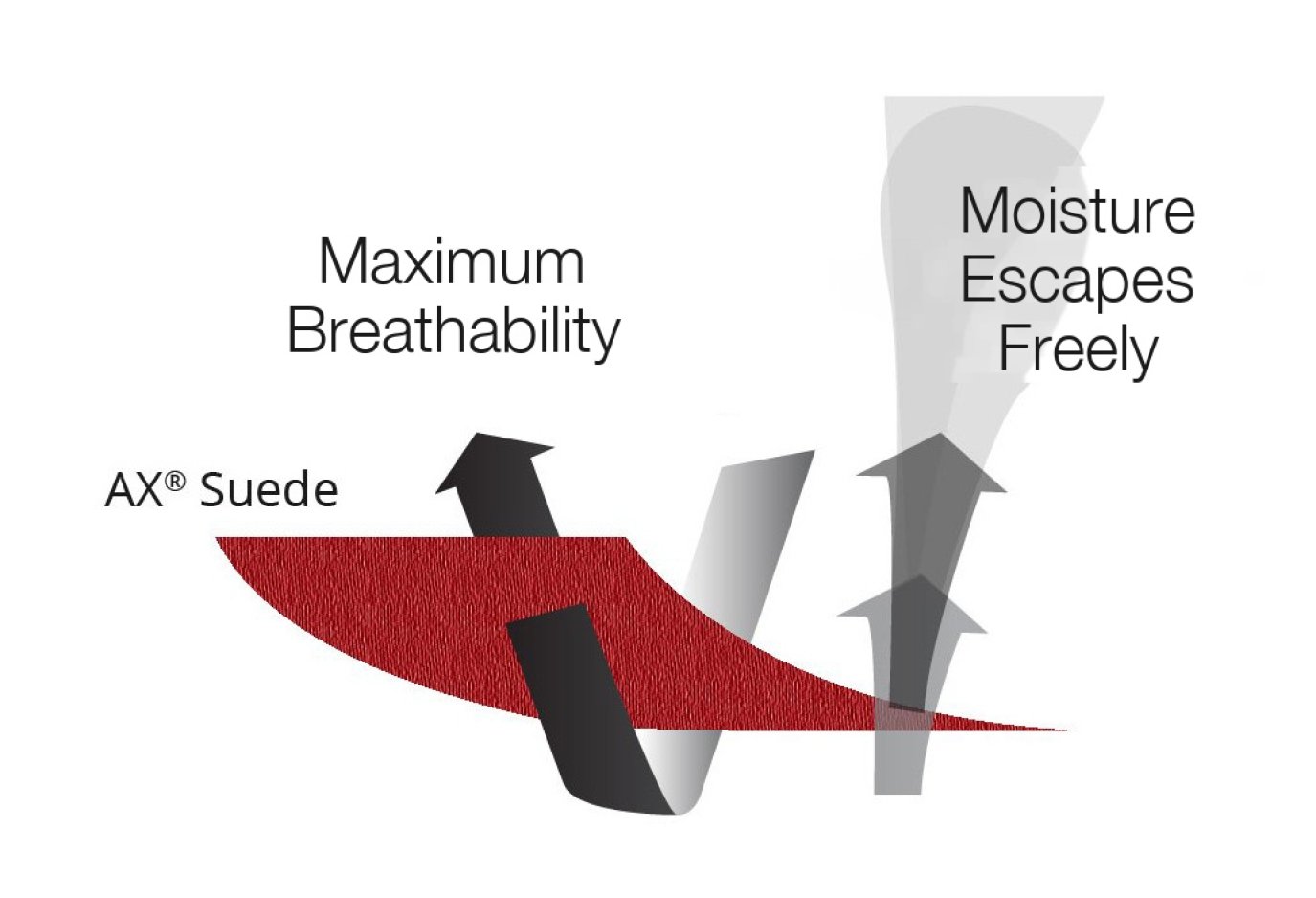
AX® materials are made with knitted polyester with minimal polyurethane content, which provides greater breathability than leather and other glove materials, both synthetic and natural.
This lets heat and sweat escape easily from the glove palm and ensures a secure, grippy, dry hold.

The chart shows a comparison of 0.75 mm Ax Grane Laredo synthetic leather and 1.1 mm cowhide in abrasion resistance and breathability.
AX® products are designed to outperform all other materials and improve performance in use. AX® Materials have proven their effectiveness in various jobs and industries, regardless of conditions. Special high-density yarn combined with other “working fibers” in a complex knitting process creates an optimal balance of strength, softness and flexibility.

The photo shows the wear of 0.8 mm AX synthetic suede after 4,000 cycles of disc abrasion under a 1 kg load. Standard cowhide suede does not last even 1,000 cycles.
Your hands work hard, and a good grip helps reduce the strain. AX® materials have polyurethane and silicone coatings with various textures and embossing, providing superb grip and protection.
AX® materials give your gloved palm a second-skin feel: they don’t slip, they keep sensitivity and they are unnoticeable when bending.
Icon Motosports is among the first to get access to advanced technologies, including AX materials, which are most widely used in motorcycle gloves. Ax Laredo leather glove palms easily pass all certification tests for the USA, Europe and Japan. Almost all the gloves can be used with touchscreens. Some models are made entirely of AX leather or suede.
Icon collections also include motorcycle jackets and vests made partly or entirely of Ax Laredo. As a rule, such models cost not much more but outperform the others in use.
PPE:
Icon® motorcycle gloves are considered personal protective equipment (PPE) under EU Directive 89/686/EEC. The motorcycle gloves described in this manual are Category II PPE, so the CE marking may be applied to them only after obtaining a CE certificate of conformity and subsequent certification by an EU notified body. The CE marking on protective gloves indicates compliance with the basic health and safety requirements of Directive 89/686/EEC and/or the essential health and safety requirements of Regulation (EU) 2016/425. The protective gloves have passed CE type-examination testing at the notified body Ricotest s.r.l, No. 0498, for compliance with Directive 89/686/EEC and/or Regulation (EU) 2016/425. In addition, this protective equipment has been inspected and tested for compliance with the following technical standards: EN 13594:2015 “Protective gloves for motorcycle riders — requirements and test methods”.
PROHIBITIONS AND LIMITATIONS OF USE:
Icon® motorcycle gloves are intended for use only as motorcycle gloves. Icon® motorcycle gloves may be used only for riding road motorcycles. Icon® motorcycle gloves are designed to provide limited protection only in certain circumstances. Icon® motorcycle gloves are intended for use in combination with other protective equipment. Using Icon® motorcycle gloves in combination with any other PPE or motorcycle riding gear does not mean that such PPE or riding gear complies with CE standards. For additional protection when riding a motorcycle, Icon® strongly recommends always using several mutually compatible PPE items, including a certified helmet, a jacket with shoulder and elbow impact protection, a certified back protector, pants with certified knee, shin and hip impact protectors, certified gloves and boots. Motorcycling is dangerous, so using Icon® motorcycle gloves cannot prevent injury or death. The level of risk or danger a rider will face is closely related to their riding style and the type of crash. Riders should choose their protective motorcycle gloves carefully according to the nature of their riding and the level of risk they are exposed to.
CE MARKING WARNINGS
Below is an example of the CE marking and other markings on Icon® motorcycle gloves in accordance with Directive 89/686/EEC, Regulation (EU) 2016/425 and EN 13594:2015. The CE marking is shown on a label attached to the gloves.
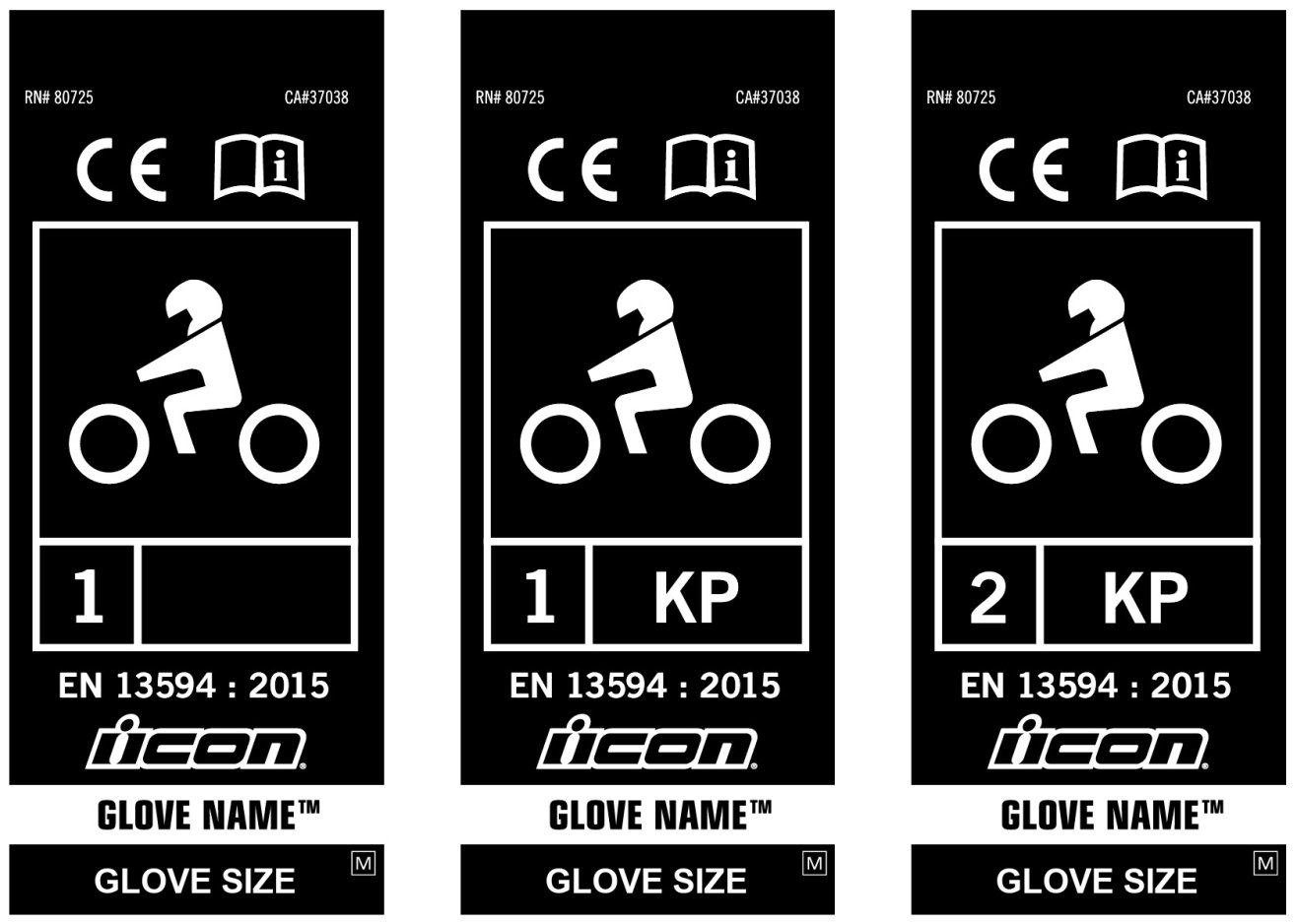
MARKING EXPLAINED
CE
The CE marking indicates that the protective gloves comply with the basic health and safety requirements of Directive 89/686/EEC and/or the essential health and safety requirements of Regulation (EU) 2016/425.
Open book pictogram
Pictogram indicating that a user manual (information sheet) is supplied with this product.
Motorcyclist pictogram
Special symbol indicating that the protective gloves are intended for motorcycle riding only.
1 or 2
Performance level of the protective gloves according to EN 13594:2015 during testing.
1 or 2 means the gloves meet the minimum requirements for cuff length, restraint straps, tear strength, seam strength, cut resistance and abrasion resistance for protection level 1 or 2.
Level 1 gloves: protection level 1 is considered the minimum level required for effective protection in a crash. Gloves of this level provide an optimal level of comfort for any riding style.
Level 2 gloves: level 2 is a higher level of protection, but stronger protection means heavier gear and less comfort, so this level is not suitable for every rider.
KP
KP is a special designation indicating that the gloves meet the requirements for knuckle impact protection for the stated protection level. If this field is left blank, the test was not carried out.
For level 1 gloves, knuckle impact protection is optional.
For level 2 gloves, knuckle impact protection is mandatory.
For more information on the performance level of these protective gloves, see the “Performance” section of this manual and Table 2 “Type tests of motorcycle gloves for compliance with the minimum requirements of EN 13594:2015” in that section.
EN 13594:2015
Technical standard
Icon logo
Manufacturer’s name or logo
PRODUCT NAME
Name or internal technical code of the protective gloves
GLOVE SIZE
Size of the protective gloves. See the size tables in the “PPE fit” section of this manual.
M / W
M = men’s gloves
W = women’s gloves
In addition to the markings described above, other coded data that Icon® uses for its products may be present. Coding may also appear in other versions of the marking.
PROTECTION LIMITATIONS
Icon® motorcycle gloves protect the user from external conditions without impairing their ability to operate the motorcycle’s hand controls. Icon® motorcycle gloves are designed for safety and freedom of movement. Icon® motorcycle gloves are classed as PPE because they are designed to provide limited protection of the hands in a crash or fall from a motorcycle. Additional dangers in road accidents involving a motorcycle may come from impacts with the motorcycle and collisions with other vehicles and objects on the road. The likelihood of serious injury increases if the hand becomes trapped under the motorcycle while sliding. Icon® motorcycle gloves do not prevent injuries caused by heavy impacts, injuries caused by severe bending, twisting, torsion or crushing from hitting an object, injuries caused by very sudden movements, or extensive penetrating injuries. The force levels used in testing cannot be directly compared with the forces riders are exposed to in real crashes, so products that meet EN 13594:2015 can only reduce the severity of some minor injuries. No protective gloves can provide complete protection against all injuries. The principle is to create a product that helps reduce the risk of injury to the area this PPE was designed to provide limited protection for.
PPE FIT:
For maximum protection, PPE must be worn so that it securely covers vulnerable areas of the body. If the PPE design includes protective features, the PPE must fit the user correctly to be positioned properly.
The correct fit of protective gloves is very important. The fit of different types of protective gloves varies depending on design and construction. Use only protective gloves that fit your hands precisely. Do not use protective gloves of the wrong size. Motorcycle gloves should be worn over or under the jacket sleeves so that the jacket sleeves and glove cuffs overlap.
Motorcycle glove size usually depends on palm circumference. To choose the right size of Icon® motorcycle gloves, measure your palm circumference. Compare your measurements with the table below to determine your approximate size. If the glove in the selected size does not fit, try a larger or smaller size.
Men’s sizes
| S | M | L | XL | 2XL | 3XL | 4XL | |
|---|---|---|---|---|---|---|---|
| cm | 16.5–17.8 | 19.1–20.3 | 21.6–22.9 | 24.1–25.4 | 26.7–27.9 | 29.2–30.5 | 31.8–33.0 |
| inches | 6.5–7 | 7.5–8 | 8.5–9 | 9.5–10 | 10.5–11 | 11.5–12 | 12.5–13 |
Women’s sizes
| XS | S | M | L | XL | 2XL | |
|---|---|---|---|---|---|---|
| cm | 14.6–15.3 | 15.9–16.5 | 17.1–17.8 | 18.4–19.1 | 19.7–20.3 | 21.0–21.6 |
| inches | 5.75–6.0 | 6.25–6.5 | 6.75–7.0 | 7.25–7.5 | 7.75–8.0 | 8.25–8.5 |
Make sure the gloves do not interfere with operating the motorcycle. For maximum protection and safety, protective gloves must not cause discomfort or restrict the rider’s freedom of movement, or prevent access to and use of the motorcycle controls in the normal riding position. If you cannot find comfortable protective gloves of this type, use another type of CE-certified protective gloves.
PERFORMANCE
Icon® protective motorcycle gloves have passed CE type-examination testing for compliance with Directive 89/686/EEC and/or Regulation (EU) 2016/425. In addition, they have been inspected and tested for compliance with the appropriate technical standard. The European standard EN 13594:2015 provides for two levels of protection depending on the protective features. The level of risk or danger a rider will face is closely related to their riding style and the type of crash. According to EN 13594:2015, protection level 1 is considered the minimum level required for effective protection in a crash. Gloves of this level provide an optimal level of comfort for any riding style. If the rider’s riding style or sport involves increased risk, level 2 protective equipment with a higher level of protection is recommended. However, stronger protection means heavier gear and less comfort, so this level is not suitable for every rider.
TABLE 2. TYPE TESTS OF MOTORCYCLE GLOVES FOR COMPLIANCE WITH THE MINIMUM REQUIREMENTS OF EN 13594:2015
| Test | Standard | Unit | Level 1 | Level 2 |
|---|---|---|---|---|
| Cuff length | Clause 4.5 | mm | ≥ 15 | ≥ 50 |
| Restraint strap | Clause 4.6 | N | ≥ 25 | ≥ 50 |
| Tear strength (protective layer) | Clause 4.7 | N | ||
| Palm and palm side of fingers | ≥ 25 | ≥ 35 | ||
| Cuff, back of hand and back of fingers | ≥ 18 | ≥ 30 | ||
| Fourchettes (panels between fingers) | ≥ 18 | ≥ 25 | ||
| Seam strength (protective layer) | Clause 4.8 | N/mm | ||
| Main seams | ≥ 6 | ≥ 10 | ||
| Fourchettes (panels between fingers) | ≥ 4 | ≥ 7 | ||
| Cut resistance (all layers) | Clause 4.9 | index | ||
| Palm side | ≥ 1.2 | ≥ 1.8 | ||
| Back side | Not required | ≥ 1.2 | ||
| Abrasion resistance (palm side, all layers): see Fig. 1 | Clause 4.10 | seconds | ||
| Single test time | ≥ 3.0 | ≥ 6.0 | ||
| Average abrasion time | ≥ 4.0 | ≥ 8.0 | ||
| Knuckle protection (optional for level 1) | Clause 4.11 | kN | ||
| Single impact | ≤ 9.0 | ≤ 5.0 | ||
| Mean impact force | ≤ 7.0 | ≤ 4.0 |
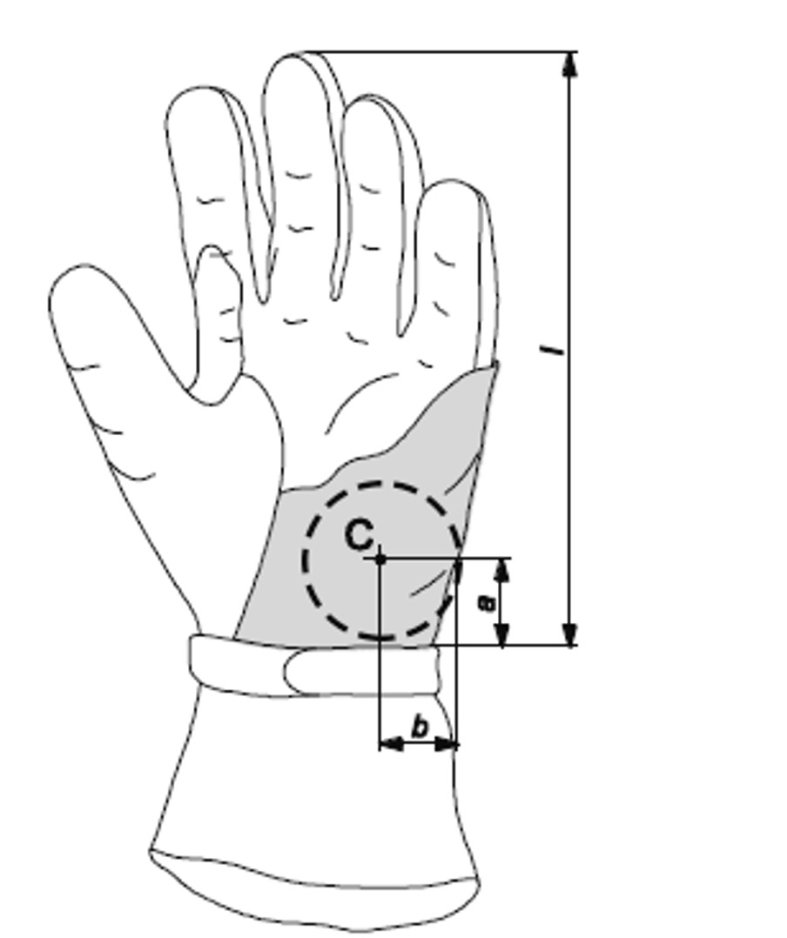
FIG. 1. THE GLOVE AREA ON WHICH THE ABRASION RESISTANCE TEST WAS CARRIED OUT
In the event of a mechanical impact or crash:
In the event of an impact or crash, key parts of the protective gloves may be damaged, and the gloves may no longer provide limited protection against the impacts described in the “Prohibitions and limitations of use”, “Performance” and “Protection limitations” sections. Damage may not be visible on simple visual inspection. In the event of an impact or crash, the gloves should be replaced. New motorcycle gloves can be purchased from Icon® retailers.
Two-year rule:
As a rule, lightweight PPE such as Icon® motorcycle gloves should be replaced every two years, even if there is no visible damage. Damage may not be visible on simple visual inspection.
Disposal:
At the end of their service life, Icon® motorcycle gloves should not be thrown away with household waste. Dispose of the gloves according to local disposal requirements.
RELEASE OF THE MANUFACTURER FROM LIABILITY BY THE PRODUCT OWNER
NO PERSONAL PROTECTIVE EQUIPMENT CAN PROVIDE PROTECTION AGAINST ALL TYPES OF IMPACTS. NO RIDING GEAR CAN PROVIDE COMPLETE PROTECTION AGAINST ALL TYPES OF INJURIES. MOTORCYCLING IS INHERENTLY DANGEROUS, AND USING THIS GEAR CANNOT PREVENT INJURY OR DEATH. BY USING THIS GEAR, THE USER ASSUMES ALL RISKS ASSOCIATED WITH THIS ACTIVITY THAT MAY RESULT IN INJURY OR DEATH. THE USER HEREBY WAIVES ALL CLAIMS AND LAWSUITS AGAINST Icon® (A DIVISION OF LEMANS CORPORATION) AND LEMANS CORPORATION IN THE EVENT OF DEATH OR INJURY RESULTING FROM THE USE OF Icon® PRODUCTS.
CARE INSTRUCTIONS
Cleaning: use a damp cloth or sponge to clean the outer leather parts of the glove. Do not use solvents or other toxic substances to clean the gloves. Do not use hair dryers or other heaters to dry the gloves after cleaning.
Care: Icon® motorcycle gloves require no additional care beyond cleaning and inspection.
Storage: gloves should be stored in a dry, ventilated room away from sunlight and heat sources. Make sure the gloves will not be subjected to impacts, drops or other influences that could damage them during storage. Do not store the gloves under heavy objects. Do not store the gloves in a way that their weight rests on only a few separate points. If the gloves get wet during use, dry them in a ventilated room at room temperature before storing; do not use hair dryers or other heaters.
Transport: when transporting the gloves, do not leave them in a closed car for long periods and do not expose them to very high or low temperatures. Make sure the gloves will not be subjected to impacts, drops or other influences that could damage them during transport. Do not transport the gloves under heavy objects.
Spare parts: no spare parts are available for Icon® motorcycle gloves.
Repair: if damaged, Icon® motorcycle gloves must be replaced. Icon® does not repair gloves.
SAFETY INSTRUCTIONS
Before each use:
Inspect the gloves carefully before each use. Check the gloves for any damage, and the leather, textile, rubber, plastic or other parts or materials for signs of tears, cracks or wear. Make sure the seams have not split or come undone and the protective foam is not damaged. Carefully check the hook-and-loop closure material for any debris and dirt that could prevent the glove from fastening securely. Replace the gloves immediately if any part of the glove, including fasteners, closures or wrist strap parts, shows signs of wear, is broken or damaged in any way and does not work properly.
Misuse that impairs the performance of Icon® motorcycle gloves:
Misuse of Icon® motorcycle gloves can seriously impair their effectiveness and performance. For Icon® gloves to retain their original protective properties, they should only be used for the purposes listed in the “Prohibitions and limitations of use” section in the “Safety” tab. Do not modify any glove components. Never bend or twist the gloves excessively, as they are not designed for this. Do not paint the gloves or use dyes of any kind.
Environmental conditions that impair the performance of Icon® motorcycle gloves:
Contamination with foreign substances and/or improper care can significantly impair the effectiveness and performance of Icon® motorcycle gloves. Protect Icon® motorcycle gloves from extremely intense direct sunlight or extremely high humidity. Protect Icon® motorcycle gloves from extremely high or low temperatures, for example when stored in a closed car or outdoors.
When choosing a size, compare the measurements in the table with those of a garment you find comfortable. Keep in mind that riding gear has built-in protection and denser materials.
On our forum we share experience of choosing motorcycle gloves remotely.
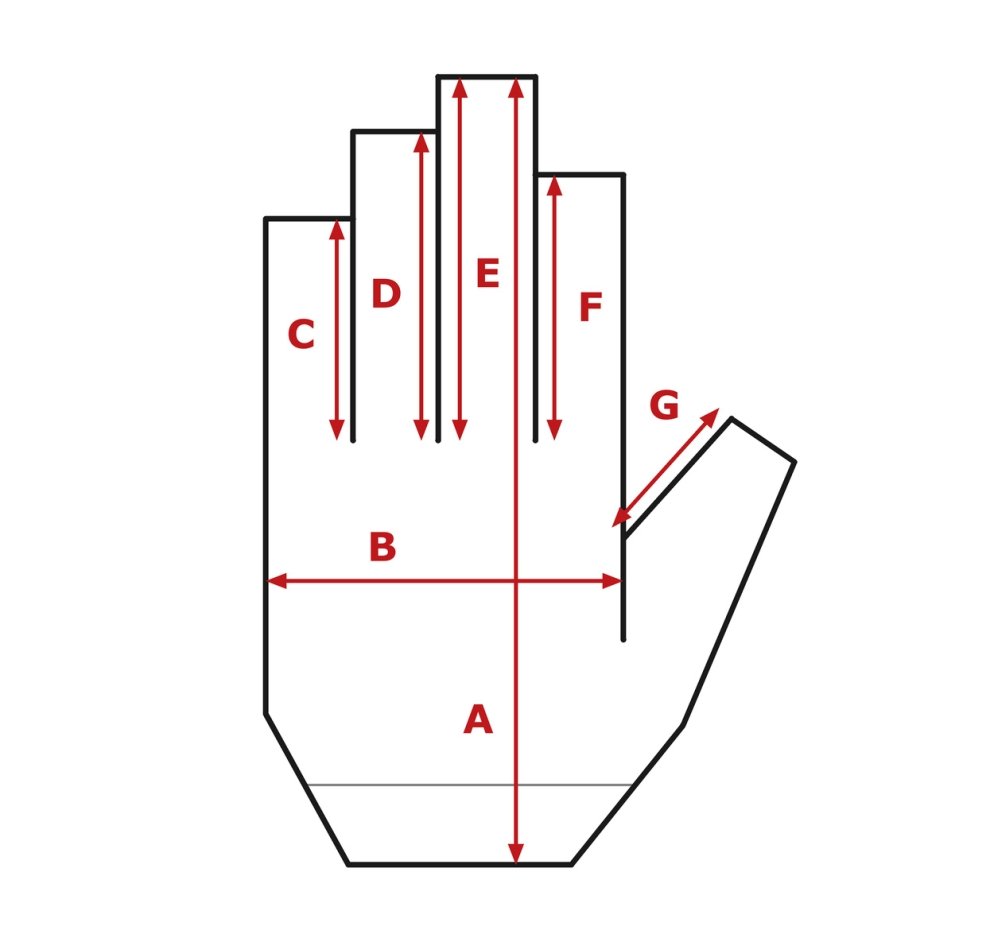
The table below shows the outer dimensions in millimeters, measured with a tape measure. The glove lies freely on a table in its natural position. We measure finger length by inserting a ruler between the fingers as far as it goes. [A] — the glove dimension from the tip of the middle finger to the bottom edge of the glove on the palm side. Accordingly, this dimension is larger on long gloves than on short ones. [B] — the glove width on the palm side.
We recommend measuring your palm width with a tape measure and adding 13–20 mm to it, depending on your palm thickness and fit preference — this will be the glove dimension [B].
| A | B | C | D | E | F | G | |
|---|---|---|---|---|---|---|---|
| S | 220 | 105 | 56 | 66 | 80 | 70 | 62 |
| M | 225 | 114 | 59 | 74 | 81 | 74 | 70 |
| L | 237 | 119 | 59 | 73 | 84 | 72 | 74 |
| XL | 241 | 120 | 64 | 79 | 86 | 74 | 70 |
| 2XL | 243 | 125 | 65 | 76 | 86 | 75 | 68 |
| 3XL | |||||||
| 4XL |


