


Your advantage lies in the evolution of the streets. The modern rider is always in the crosshairs. Every kilometer is a test of attention, skill and composure. The enlarged eye port with a full-size visor provides an excellent view with no obstructions or blind spots, and the Dropshield Ultra™ system offers maximum on-demand protection for your eyes from the sun. The aggressive helmet profile is complemented by Speedwing Supervent ventilation, which improves stability and airflow at high speeds. Inside the vented EPS liner with deep channels is the MIPS brain protection system, which reduces the effects of angled impacts. Even in a solid color, the Ultraflite speaks for itself — a bold shield against the harshest realities of the street.
SHELL
FIT
OPTICS
VENTILATION
COMFORT
NOISE
HEADSET
PERSONALIZATION
SAFETY
No motorcycle helmet in the world can protect against ALL possible impacts. For your safety, you need to choose a helmet that fits correctly. For maximum head protection, the helmet must fit snugly and follow the shape of your skull as closely as possible. To work properly, the helmet must be securely fastened under the chin.
Wrap a flexible measuring tape around your head at its widest point above the eyebrows and ears.
Using this measurement, find your size in the size charts below according to the helmet brand and model:
ICON AIRFLITE / DOMAIN / THRESHOLD
BILTWELL LANE SPLITTER / GRINGO S SV
THOR FLEET / SECTOR 2
| Shell | 2XS | XS | S | M | L | XL | 2XL | 3XL |
|---|---|---|---|---|---|---|---|---|
| Circumference cm | 51–52 | 53–54 | 55–56 | 57–58 | 59–60 | 61–62 | 63–64 | 65–66 |
ICON ULTRAFLITE / AIRFRAME PRO
THOR REFLEX
| Shell | XS | S | M | L | XL | 2XL | 3XL |
|---|---|---|---|---|---|---|---|
| Circumference cm | 54–55 | 55–56 | 57–58 | 58–59 | 60–61 | 62–63 | 64–65 |
ICON AIRFORM
| Shell | XS | S | M | L | XL | 2XL | 3XL |
|---|---|---|---|---|---|---|---|
| Circumference cm | 53–54 | 55–56 | 57–58 | 58–59 | 60–61 | 62–63 | 64–65 |
Skull shape in the horizontal plane is just as important as circumference. To determine your head shape, put on a balaclava (it will flatten your hair) and take a photo of your head from above, or ask someone to assess it. Round head — width and length are almost the same, it fits into a circle. Intermediate oval head — slightly longer than it is wide, the most common skull shape, it fits into a regular oval. Long oval — noticeably longer than it is wide, it fits into a narrow oval.
Different helmet models are made for different skull shapes — keep this in mind when choosing a helmet:
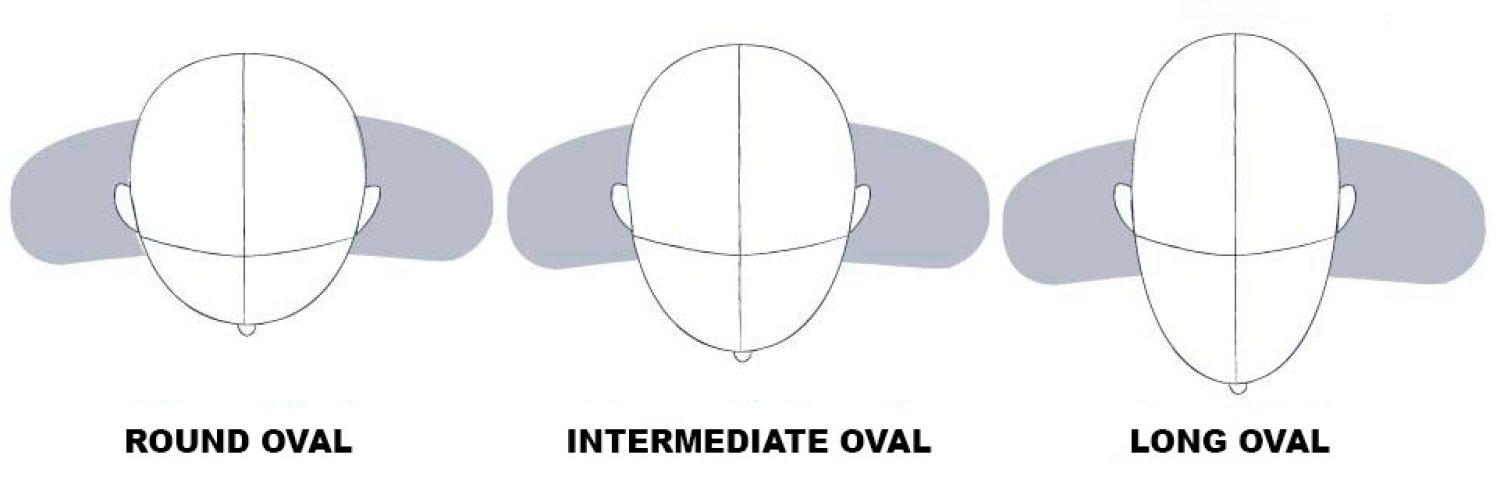

If you can’t determine your head shape (this sometimes happens), it is most likely an intermediate oval, because a round head shape (equal length and width) is the most obvious.
If your head shape doesn’t match the helmet shape, you need to go one or two sizes up, depending on how big the difference in skull oval is. In that case the liner will fit your skull unevenly and not over its whole area, which has a negative effect on impact energy absorption as well as on the helmet’s noise insulation.
NOTE: The helmet’s inner pads compress with use — keep this in mind when trying it on. The helmet should fit snugly and should not press painfully on your skull. The pressure on your cheeks can be quite strong, and they may be squeezed. The cheek pads are the thickest and compress the most.
We don’t believe you need to wear a helmet for a while to get used to it. A helmet chosen correctly by size and shape fits comfortably and snugly right away — proven by hundreds of customers! The only thing that may be uncomfortable is a tight entry when taking the helmet off and putting it on. Over time the pads at the entry will soften, and the helmet will be much easier to put on and take off. Focus on how your head feels inside the helmet!
A technology, built into helmets and designed to help reduce rotational motion to the head that could occur in so-called oblique impacts.
We have over 25 years of research into rotational motion and helmet safety, and an abundance of studies and data that say the same thing: in the vast majority of accidents in which someone hits their head, the impact is oblique, and an oblique impact entails an increased risk of brain damage. The same thing goes for objects falling from above at, for instance, a building site: they cause an oblique impact — even if you are standing still.

The moment your head hits the ground at an angle, rotational motion can make the head rotate more or less, depending on the impacting object or surface. The energy from the impact can be directed further into the head, which can cause brain injury. Rotational motion is thus the result of oblique impacts to the head.

The brain is more sensitive to oblique impacts versus straight impacts. Oblique impacts are also much more common. But most helmets on the market today are only tested and approved for straight impacts, even though these kinds of accidents are far less common.
Everything revolves around the Mips low-friction layer. It mimics the brain’s own protective system, which allows the brain to move slightly inside the head. The Mips system is designed to work on the same principle. The low-friction layer is built into the helmet and makes the energy-absorbing layers (the “padding”) mobile so that the head can move 10–15 mm inside the helmet on impact.

The Mips® safety system is available in different designs for different areas of use, but the principle is the same for all options. The system is attached to the helmet with elastic material, ensuring that the low-friction bearing is always in the proper position. The low-friction bearing has also been specially engineered to fit each helmet model and size and is injection-molded to fit perfectly inside each individual helmet. It provides a minimalist, fully integrated design that neither interferes with the helmet’s fit nor affects the weight more than marginally. A Mips system weighs between 20 and 45 grams.
Mips is a technology that is based on many years of research into the brain and brain damage, and we are firmly rooted in science. Our story begins in 1995, when brain surgeon Hans von Holst from Karolinska Institutet in Stockholm, Sweden, began researching helmet construction. He based his research on the realization that the helmets available at the time did not offer sufficient protection against brain damage. He contacted the KTH Royal Institute of Technology in Stockholm to initiate biomechanical research on the prevention of head and neck injuries.

The initiative led to what is now recognized as one of the most important Finite Element (FE) models of the human brain in the world. The model is an important research tool for Mips when it comes to visualizing and measuring the effects of the Mips system. Our first product was a proprietary riding helmet launched in 2007. Since then, Mips has become an “ingredient brand,” which means we sell our technology to other manufacturers, who in turn incorporate it into their products. Today, our safety systems are found in helmets for everything from skiing and cycling to construction and industry.

AX® Materials became known for developing a synthetic leather specifically for gloves that outperformed natural leather in every respect.
The first product was AX® Suede Original, which set the industry standard for comfort, flexibility, high abrasion resistance and tear strength. Since then the range of materials has grown and now includes various types of synthetic leather and mesh textiles, including touchscreen-compatible ones.

Gloves made of AX leather with no damage or significant wear after 122 hours of testing in construction work.
Today AX® materials are used in many products beyond gloves: clothing, workwear, bags, sports equipment of all kinds and riding gear. AX® materials are used by more than 150 brands worldwide (Dakina, Watson, Akta, Mog, Viktos, Loffi, Chromag, Bike Radar and others) to take their gear to a new level of performance.

AX® Materials uses specially structured synthetic polyester fibers to create thin, strong and flexible materials.
These polyester fibers last longer and keep their integrity better than natural suede and leather, while being more breathable and flexible.
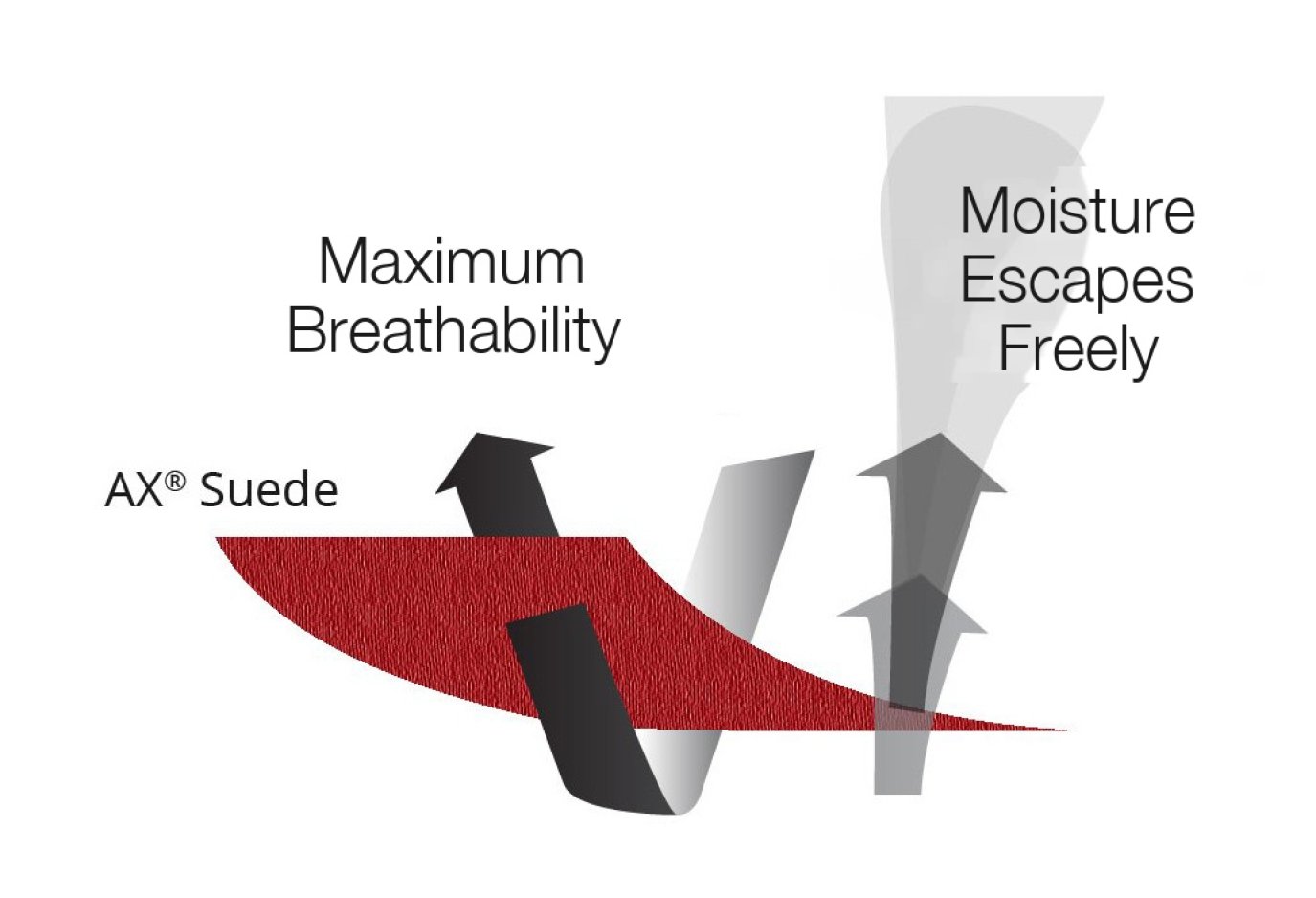
AX® materials are made with knitted polyester with minimal polyurethane content, which provides greater breathability than leather and other glove materials, both synthetic and natural.
This lets heat and sweat escape easily from the glove palm and ensures a secure, grippy, dry hold.

The chart shows a comparison of 0.75 mm Ax Grane Laredo synthetic leather and 1.1 mm cowhide in abrasion resistance and breathability.
AX® products are designed to outperform all other materials and improve performance in use. AX® Materials have proven their effectiveness in various jobs and industries, regardless of conditions. Special high-density yarn combined with other “working fibers” in a complex knitting process creates an optimal balance of strength, softness and flexibility.

The photo shows the wear of 0.8 mm AX synthetic suede after 4,000 cycles of disc abrasion under a 1 kg load. Standard cowhide suede does not last even 1,000 cycles.
Your hands work hard, and a good grip helps reduce the strain. AX® materials have polyurethane and silicone coatings with various textures and embossing, providing superb grip and protection.
AX® materials give your gloved palm a second-skin feel: they don’t slip, they keep sensitivity and they are unnoticeable when bending.
Icon Motosports is among the first to get access to advanced technologies, including AX materials, which are most widely used in motorcycle gloves. Ax Laredo leather glove palms easily pass all certification tests for the USA, Europe and Japan. Almost all the gloves can be used with touchscreens. Some models are made entirely of AX leather or suede.
Icon collections also include motorcycle jackets and vests made partly or entirely of Ax Laredo. As a rule, such models cost not much more but outperform the others in use.

The motorcycle helmet meets the following safety standards:
The fiberglass or carbon (depending on the model) composite shell of the ICON® ULTRAFLITE™ helmet is made to strict quality control standards.
The dual-layer expanded polystyrene (EPS) liners in the ICON® ULTRAFLITE helmet are designed for maximum impact absorption and energy dissipation. In addition, both liners have an extensive system of directed ventilation channels that distribute airflow from the external ventilation system.

HELMET COMPONENTS

Riding a motorcycle is a dangerous activity. No helmet can fully protect the user from all possible impacts. Always wear a helmet, eye protection, protective clothing, gloves and footwear when riding. Even if you use the helmet described in this manual, there is no guarantee that serious injury or death can be prevented.
When riding a motorcycle, take all precautions to minimize risk. This helmet is not designed to protect against fire and does not contain fire-resistant materials. Make sure your ICON® helmet fits you correctly. Incorrectly sized or misused products can lead to serious injury or death.
Instructions on how to choose the right helmet size are in every helmet product page on our website, in the “SIZE” tab.
Any helmet that has been subjected to an impact must be replaced. A helmet is designed to absorb only one impact. It absorbs part of the energy through partial destruction of the shell and inner layer. After an impact, the inner shock-absorbing layer (liner) dissipates the energy, which compresses the material and makes it lose its protective properties. This damage may be invisible. Even if no external damage is visible, the helmet loses its effectiveness after one impact. Such a helmet must be destroyed and replaced, even if it looks undamaged.
To provide proper protection, the helmet must fit snugly on the head and be securely fastened. Although no helmet can fully protect the user from all possible impacts and crashes, proper use of this helmet will provide a much higher level of protection than riding without one.
For the helmet to do its job, reduce the risk of injury or death and provide maximum protection, it must fit snugly on the head and have a securely fastened retention system (chin strap). With the strap adjusted comfortably but snugly, the helmet must not come off the head when pulled up and forward from the back.
Helmet fit is crucial to its protective properties. Different helmet models may fit differently due to differences in construction and shape. The right helmet size can only be determined by trying it on. Always try on a helmet in a store before buying to make sure it fits you. If you cannot find a suitable size in this model, try another certified motorcycle helmet model.


Correct fastening and tension of the chin strap are crucial to the helmet’s effectiveness. If the strap is not fastened or is tightened incorrectly, the helmet may not work properly or may come off in a crash, which can result in serious injury or death.
If you cannot correctly fasten or adjust the strap retention system on this helmet, do not use it for riding — choose another certified helmet that fits you.
NEVER ride with the strap unfastened! This can result in injury or death. For the helmet to work properly, the strap must always be securely fastened during use. Periodically check that the strap remains firmly secured. If you feel the strap has loosened while riding, stop immediately in a safe place and adjust the tension to the correct level.


To unfasten the D-ring strap:
To securely fasten the strap with the D-ring system:
IMPORTANT: The snap only serves to secure the loose end of the strap so that it does not flap in the wind while riding. It is not part of the helmet retention system and must not be used on its own without correctly fastening the strap through the D-rings as shown in the illustration.
Make sure your helmet is in good condition before each use. Always check the helmet for loose parts, screws and rivets, a worn chin strap, cracks and other signs of wear or damage that could prevent you from fastening and wearing the helmet correctly. Before each use, make sure the inner liner and cheek pads are correctly installed and the chin strap system is securely fastened.
The visors (face shields) supplied with this helmet meet the requirements of VESC-8 Regulation.
SAFETY WARNING: DO NOT RIDE WITHOUT CERTIFIED EYE PROTECTION THAT MATCHES THIS HELMET AND IS DESIGNED FOR MOTORCYCLE USE. FAILURE TO USE APPROVED EYE PROTECTION MAY RESULT IN SERIOUS INJURY OR DEATH.
SAFETY WARNING: DO NOT RIDE WITHOUT THE VISOR FULLY CLOSED. IF THE VISOR IS OPEN WHILE RIDING, THE AIRFLOW MAY TEAR IT OFF THE HELMET. IMPROPER USE OF THE VISOR MAY RESULT IN SERIOUS INJURY OR DEATH.
SAFETY WARNING: DO NOT RIDE USING ONLY THE INTERNAL DROP-DOWN VISOR WITH THE MAIN VISOR OPEN. THIS MAY RESULT IN SERIOUS INJURY OR DEATH.
WARNING: VISORS
WARNING: INTERNAL DROP-DOWN SUN VISOR (if fitted)
WARNING: PINLOCK® INSERT (if fitted)
WARNING: TEAR-OFF FILMS (if used)


Inspect the visor. Make sure the visor mechanisms work properly and provide sufficient transparency and clear visibility. Remove dirt, insects, marks or any other contamination that could impair your view. A dirty visor greatly reduces visibility, so for your safety clean it immediately.
Check the visor for physical damage, cracks and scratches. A scratched, cracked or otherwise damaged visor significantly impairs visibility and must be replaced.
Wearing any helmet reduces your ability to hear surrounding sounds. The user should be aware of this reduced hearing and keep a close eye on their surroundings. Ignoring this fact may lead to an accident that can cause serious injury or death.
Before using any communication system built into the helmet, make sure you know and understand the local, regional, national and international rules on using communication devices while operating a vehicle — in all regions where you plan to travel.
The ICON® Ultraflite™ helmet has an enlarged adjustable front chin vent, two adjustable upper forehead vents and two upper adjustable Supervent air intakes.
Large switches that are easy to operate with gloves give easy access to ventilation adjustment on the move, and a large adjustable rear exhaust channel effectively draws hot air out.
To open the front chin vent (1a), push down on the vent switch inside the chin bar. To close it, simply push the same switch up (1b).

The two main forehead vents (2a) open when you push the vent covers up. To close them, push the covers down (2b).

The two upper Supervent vents (3a) open when you slide the aerodynamic spoiler back. To close them, slide the spoiler forward (3b).

SAFETY WARNING: The comfort liner and cheek pads are integral parts that ensure the helmet works correctly and protects properly. They must be correctly installed every time the helmet is used. Incorrect installation of the liner or cheek pads may result in serious injury or death.
The ICON® Ultraflite™ helmet has an interior lining made of the exclusive moisture-wicking HydraDry™ material for comfort and dryness.
Helmet size is determined by a combination of three factors: the size of the outer shell, the thickness of the inner EPS layer, and the thickness of the interior components (liner and cheek pads).
The helmet fit can be customized by replacing the cheek pads with thinner ones for a looser fit or thicker ones for a snugger fit. To order replacement interior components, contact our shop manager.

[1] Turn the helmet upside down with the chin bar facing away from you. Release each cheek pad by pulling it inward to unsnap the snaps and hook-and-loop fasteners. Note how the chin straps pass through the pads and how the cheek pad mounting plate fits between the helmet shell and the EPS layer — this is important for reassembly.
[2] Remove the comfort liner by unsnapping it from the two snaps at the back of the helmet. Then release the two snaps in the forehead area. After that, remove the central (crown) liner, noting how its mounting plate fits between the shell and the EPS layer.
To reinstall the comfort liner and cheek pads, follow these steps in reverse order.
This helmet is equipped with an emergency cheek pad release system. This feature is designed to make it easier for rescue personnel to remove the cheek pads in an emergency.
Removing the cheek pads and helmet in an emergency involves increased risk that may result in injury or death.
Cheek pad removal should only be performed by qualified rescue personnel.
The injured person’s head must not move during this process. The head in the helmet must be stabilized and held to prevent any movement.

The chin curtain must be correctly installed when used with the helmet. Incorrect installation of the chin curtain may result in serious injury or death.
Find the locking tabs on the inside of the chin curtain. Line up the center of the curtain with the chin bar of the helmet and firmly insert the tabs into the helmet slots, pressing until they lock.
Firmly grasp the chin curtain and pull down to remove it.

ICON® helmets come with a removable chin curtain, making it easier to clean and care for the inside of the helmet. Remove the curtain following the instructions above and gently hand wash it with baby shampoo in cold water. Air dry naturally. DO NOT MACHINE WASH OR TUMBLE DRY. Hand wash and air dry only.
The service life of a helmet is limited, and it should be replaced when obvious signs of wear appear, such as: a change in fit, cracks, rust, worn or frayed parts, and any other signs of natural aging and wear that could impair the helmet’s protective properties.
Using a helmet that shows signs of wear may result in serious injury or death.
Replace this helmet 5 years after its date of manufacture (the date is shown on the inner liner of the helmet), even if it has not been damaged or subjected to impacts.
If you have bought a new helmet, destroy the old one to prevent it from being reused. Do not sell or give your old helmet to other people, even if it has not been damaged. Over time, the inner protective layer of a helmet takes the shape of the owner’s head, so when used by another person the helmet will not provide the proper level of protection, which may result in serious injury or death.
No personal protective equipment can completely prevent injury in a crash or fall from a motorcycle. No riding gear can provide absolute protection against impacts or abrasion resulting from a crash or fall.
Motorcycling is inherently dangerous, and using this helmet does not guarantee the prevention of injury or death. Even a low-speed crash can result in serious injury or death.
By using this helmet, the user assumes all risks associated with this activity that may result in injury or death.
The user hereby waives any claims against Icon® Motosports (a division of Lemans Corporation) and Lemans Corporation in the event of injury or death, and agrees not to file lawsuits related to injury or death occurring while using Icon® Motosports products.
Let’s be honest — motorcycle helmets look great, and you’d like to keep yours looking like new for as long as possible. Over many years of practice we have worked out several effective ways to do this, and we are happy to share them.
We strongly do not recommend using solvents, carburetor cleaner, brake fluid or any other substances in the cans, tins and bottles lying around your garage, including unlabeled ones, to clean your helmet. Chemicals and strong solvents can seriously damage the materials the helmet is made of — please don’t do that to your helmet!
* Never wash or dry the liner in a washing machine or dryer.
Protecting your helmet during long-term storage is definitely a good idea. Keep the helmet in the special bag included. Store it in a safe, dry place out of direct sunlight.
The visor surface must be cleaned very carefully to avoid scratches. Place a clean, warm, damp, soft cloth over the outside of the visor for at least 5 minutes to soften dried bugs and dirt (don’t skip this step!). Then gently clean the visor with a clean soft cloth, warm water and mild soap. After that, wipe the visor with a clean soft cloth dampened with clean water to remove soap residue. Dry the visor by gently wiping it with a clean soft cloth.
Never use solvents, window or glass cleaners, or any other chemical cleaners to clean the visor.
Do not apply decals, tape or stickers to the visor.
If your visor has an anti-scratch or anti-fog coating, keep in mind that household cleaners (such as glass cleaners, all-purpose sprays, furniture polish) can leave unwanted marks and in some cases damage the visor itself.
Do not use any cleaners or detergents on the inside of the visor. Using anything other than a clean soft or microfiber cloth and water to gently wipe the inside of the visor can damage or reduce the effectiveness of the anti-fog coating.
Protect the visor when it is not fitted to the helmet. Store the visor in a dry, safe place, away from direct sunlight and extremely high or low temperatures. Make sure the visor cannot be scratched, damaged by impact or otherwise deformed, is not under heavy objects and is not stored near fuel or solvents. We recommend storing the visor in a soft microfiber bag or pouch.
If your helmet has an internal drop-down visor, be sure to follow the same instructions, as they also apply to the internal drop-down visor.
Although a helmet is hard and has a very strong and reliable construction, it requires careful handling. Dropping a helmet on asphalt or another hard surface can significantly impair its functionality. The user should be aware that an impact may cause damage that is invisible to the eye.
The riding gear manufacturer ICON Motosports warns: when taking part in activities that require a helmet on your head, it is strongly recommended to avoid hitting your head on anything whatsoever. If you suspect reduced helmet functionality, or after ANY impact during use, replace the helmet. We guarantee it will cost less.


